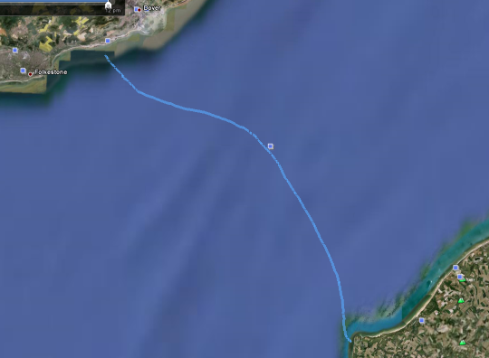
This is my planned route for the Channel. Straight line distance its about 21 miles, so with the added kink its roughly 22/23 ( the kink is necessary to take into account the currents present in the north sea.
The English Channel is one of the busiest shipping lanes in the world, with approximately 600 vessels moving up and down them every day, plus the ferries , seacats and jetfoils crossing between England and France at very regular intervals. Because of this international shipping lanes have been agreed and their areas marked on the charts.
On the English side we have the South West Lane which is for vessels traveling down Channel towards the Atlantic. The South West Lane is about 4 nautical miles wide and starts about 5 nautical miles from the British shore line.
In the middle we have a separation zone which is about 1 nautical mile wide.
On the French side we have the North East Lane for vessels which are traveling up to the North Sea areas. This lane is about 3.5 nautical miles wide.
When crossing from Dover I'll be swimming through the English inshore traffic zone into the South West shipping lane. I'll then pass into the area known as the Separation Zone (is one nautical mile wide). Then there is the North East Lane, followed by the French inshore traffic zone.
The English Coastguard's are stationed at Langdon Battery Dover, to the East of the harbour. The French Coastguard's are stationed at Cap Gris Nez. Both keep radar and VHF watch on the whole of this area liaisoning with the vessels using the Channel. They broadcast navigational bulletins every half hour and log vessel movements when they are using the lanes.
Channel swims differ from other swims of this distance by their complexity and the local environment. This is why it is one of the ultimate challenges. I will be swimming in cold water, 15°C to 18°C (hypothermia is a major consideration and cold water training is important) for between 10 to 20 hours.
The Channel has quite a lot of hazards such as seaweed and flotsam and jetsam (rubbish and timbers, etc.). It usually has a swell and when the wind is in the opposite direction to the tide it can turn quite choppy. The weather is always uncertain and local conditions can change in a very short time (30 minutes). The swim is every bit a mental swim as well as a very physical one, and I must be both mentally and physically attuned. There is an element of luck involved in getting everything to fall right on the day. The only real way to achieve success is to start with the idea that nothing else matters except arriving on the other side. I have to start with the intention of finishing, no matter what, then play the day as it comes.
For other peoples accounts of swimming the Channel, visit: http://www.channelswimmingassociation.com/swimmers_tales_39.html
